
Introduction:
Every business wants to reach the right audience, build brand awareness and generate more customers. But when planning an advertising budget, one important question often comes up: should you invest in digital marketing or traditional advertising?
From Google Ads and social media campaigns to newspaper advertisements and outdoor hoardings, each marketing channel offers different advantages. The right choice depends on your business goals, target audience, budget and expected results.
In this guide, we will explain the differences between digital marketing and traditional advertising, compare their costs and benefits, and help you decide which approach is suitable for your business.
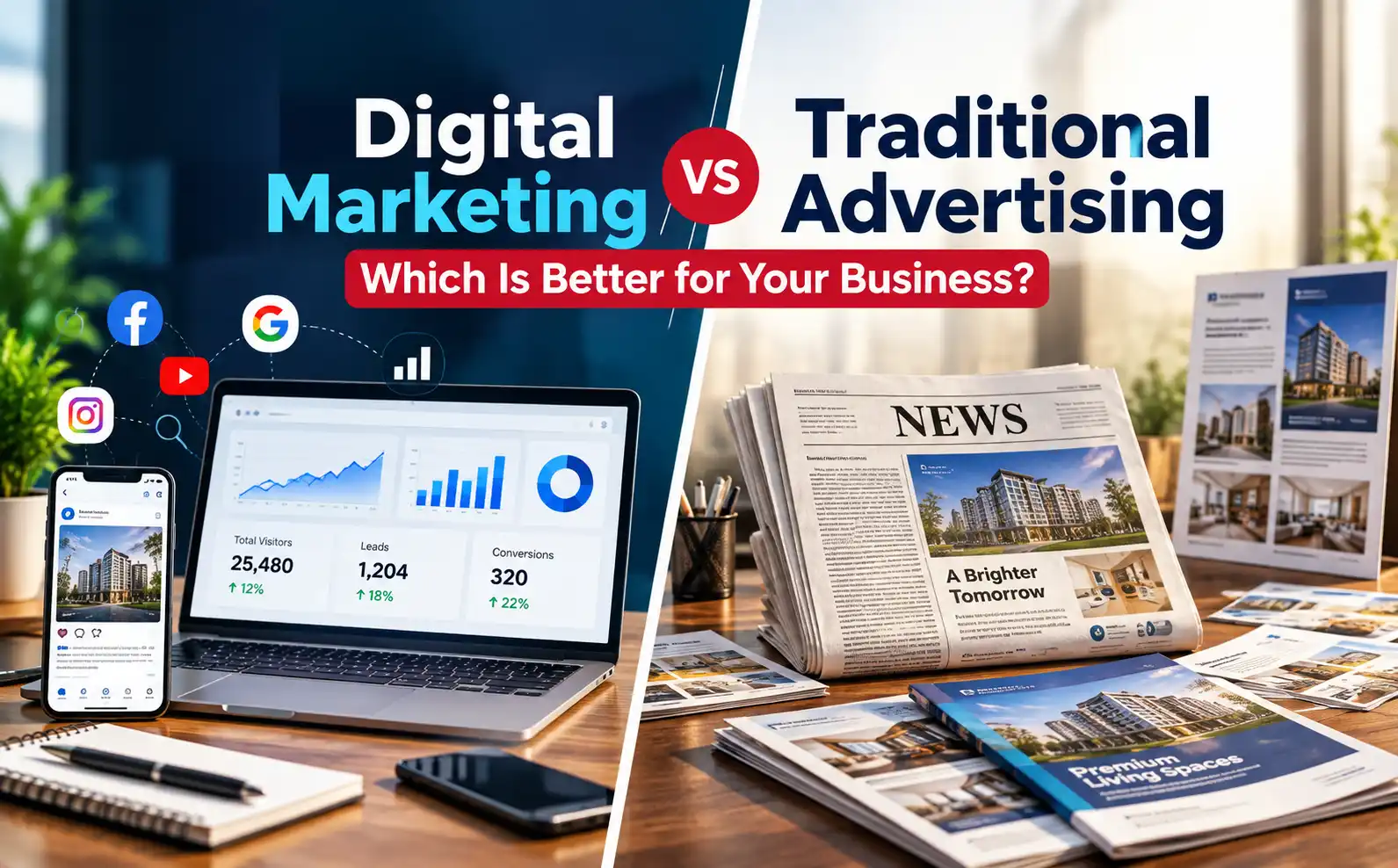
Digital Marketing vs Traditional Advertising: Quick Comparison
| Comparison Factor | Digital Marketing | Traditional Advertising |
|---|---|---|
| Advertising channels | Search engines, websites, social media, email and online video | Newspapers, television, radio, hoardings and brochures |
| Budget | Flexible and scalable | Often requires higher upfront investment |
| Audience targeting | Can target specific audiences based on location, interests and behaviour | Generally reaches broader audiences through selected media |
| Performance tracking | Offers digital metrics such as clicks, leads and conversions | Often relies on surveys, campaign codes and other indirect methods |
| Campaign flexibility | Ads can usually be edited, paused or optimised quickly | Printed or broadcast campaigns can be more difficult to change |
| Audience engagement | Supports comments, messages, clicks and online interactions | Usually focuses on one-way communication |
| Best suited for | Online visibility, lead generation and measurable campaigns | Broad awareness, local visibility and mass-market campaigns |
Neither approach is automatically better for every business. Understanding how each works will help you choose the right marketing strategy.
What Is Digital Marketing?
Digital marketing refers to promoting a business, product or service through online channels. It helps businesses connect with potential customers when they search for information, browse websites, watch videos or use social media.
Common digital marketing channels include:
- Search Engine Optimisation (SEO): Improving a website’s visibility in organic search results.
- Pay-Per-Click Advertising (PPC): Running paid advertisements on search engines and other digital platforms.
- Social Media Marketing: Building brand awareness and engaging audiences through social platforms.
- Content Marketing: Publishing useful blogs, articles, videos and other resources.
- Email and WhatsApp Marketing: Communicating with customers, sharing updates and nurturing enquiries.
For example, a Chennai-based business can use SEO to attract people searching for its services, run Google Ads to reach potential customers, and use social media to showcase its products and expertise.
Businesses looking to improve their online presence can explore Eumaxindia’s digital marketing services.
Advantages of Digital Marketing
1. Flexible budget management
Businesses can start with a defined budget, test different campaigns and adjust spending according to performance.
2. Targeted audience reach
Digital advertising platforms allow advertisers to select relevant audiences using available targeting options, such as location, interests and search intent.
3. Measurable performance
Businesses can monitor impressions, clicks, website visits, enquiries and conversions when suitable tracking is configured.
4. Quick campaign optimisation
Advertisers can test different headlines, creatives, audiences and landing pages to identify opportunities for improvement.
5. Direct customer interaction
Social media comments, messages, online reviews and website enquiry forms provide opportunities to communicate with potential customers.
Limitations of Digital Marketing
Digital marketing also requires continuous attention. Businesses may face strong competition, changing platform policies, rising advertising costs and the need for consistent content creation.
SEO and content marketing usually require sustained effort before meaningful organic growth develops. Paid advertising may generate traffic quickly, but traffic does not automatically translate into sales.
What Is Traditional Advertising?
Traditional advertising uses established offline channels to promote a brand, product or service. It is particularly useful when businesses want to reach audiences in specific locations or create broad public awareness.
- Common traditional advertising methods include:
- Newspaper and magazine advertisements
- Television and radio commercials
- Outdoor hoardings and billboards
- Bus, auto and transit advertising
- Bus shelter and railway station advertisements
- Brochures, flyers and promotional materials
- Event sponsorships and promotional activities
For example, a retail business launching a new outlet may use newspaper advertisements and outdoor hoardings to attract local attention while using digital campaigns to share offers and direct customers to its website.
Explore Eumaxindia’s outdoor advertising services to learn more about offline advertising opportunities.
Advantages of Traditional Advertising
1. Strong local visibility
Outdoor advertising can help businesses maintain a visible presence in selected locations with regular audience movement.
2. Broad audience reach
Television, radio and print advertising can expose a campaign to a wide audience through established media channels.
3. Physical brand presence
Printed materials and outdoor displays provide a visible, tangible representation of a brand.
4. Repeated brand exposure
Advertisements placed in suitable locations can help reinforce brand recognition among people who encounter them repeatedly.
5. Useful for local and mass-market campaigns
Traditional advertising can support retail launches, public awareness campaigns, regional promotions and large-scale brand-building activities.
Limitations of Traditional Advertising
Traditional advertising can involve substantial production and placement costs, depending on the medium and location. Audience targeting may be less precise than with some digital campaigns, and measuring direct sales or leads can be more challenging.
Changes to printed materials or scheduled advertisements may also require additional time and expense.
Key Differences Between Digital Marketing and Traditional Advertising
1. Cost and Budget Control
Digital marketing offers flexible budgeting options. A business can begin with a small paid campaign, monitor performance and make adjustments as needed.
Traditional advertising costs vary according to factors such as the media channel, advertisement size, placement, campaign duration and production requirements.
Which is better? Digital marketing can be a practical starting point for businesses with limited budgets. Traditional advertising may be worthwhile when the campaign objective and expected audience justify the investment.
2. Audience Targeting
Digital marketing allows businesses to target relevant audiences using available demographic, geographic, behavioural and intent-based options.
Traditional advertising generally reaches audiences through selected locations, publications, programmes or broadcast schedules.
For example, a service provider can use a location-based search campaign to reach people looking for its services in Chennai. A billboard in a relevant commercial area can support broader awareness among commuters and visitors.
Which is better? Digital marketing offers more granular targeting in many situations, while traditional advertising can provide valuable geographic visibility and broad exposure.
3. Performance Measurement and ROI
Digital campaigns can be measured through metrics such as impressions, clicks, enquiries, conversions and cost per lead. Accurate tracking and attribution are important for understanding which activities contribute to business outcomes.
Traditional advertising can also be measured using unique phone numbers, QR codes, campaign-specific URLs, promotional codes and customer surveys.
Which is better? Digital campaigns often provide more immediate and detailed performance data, but both methods benefit from clear objectives and appropriate tracking.
4. Reach and Brand Awareness
Traditional media can expose a brand to a broad audience, particularly through television, radio, print and outdoor advertising.
Digital marketing can reach audiences across different locations and connect brand awareness activities with online searches, website visits and enquiries.
Which is better? The answer depends on where the target audience spends time and how the business wants to build awareness.
5. Speed and Flexibility
Digital advertisements can often be launched, edited or paused relatively quickly. Performance data can also help marketers adjust campaigns during their run.
Traditional campaigns may require advance planning, printing, production schedules or media bookings. Changes can therefore take longer.
Which is better? Digital marketing is generally more flexible for rapid testing and optimisation. Traditional advertising is useful when a planned campaign requires a physical or broadcast presence.
Digital Marketing vs Traditional Advertising: Which Is Better for Different Businesses?
The best advertising approach depends on the business model, audience and campaign objective.
| Business type or goal | Recommended starting point |
|---|---|
| Small business with a limited budget | Digital marketing, with a focus on relevant channels |
| Local shop or service provider | Local SEO, social media and suitable local advertising |
| E-commerce business | SEO, paid search, social media and conversion optimisation |
| Brand launching a new product | A coordinated digital and traditional campaign |
| Business targeting a broad regional audience | Outdoor, print or broadcast advertising supported by digital channels |
| B2B company | SEO, professional networking platforms, relevant content and email |
| Business seeking measurable online enquiries | Targeted digital campaigns with conversion tracking |
These are starting points, not fixed rules. Your audience, competition and sales process should determine the final media mix.
Why Combining Digital Marketing and Traditional Advertising Can Work
Businesses do not always have to choose one approach over the other. Combining suitable online and offline channels can help create a more consistent customer journey.
Here are some practical examples:
- Outdoor advertising + SEO: A person sees a billboard, searches for the brand online and visits its website.
- Newspaper advertising + landing page: A print advertisement directs interested readers to a dedicated webpage through a QR code.
- Television advertising + social media: A television campaign builds awareness while social media content provides additional information and encourages interaction.
- Event promotion + digital follow-up: An offline event introduces the brand, while email or WhatsApp communications help maintain contact with interested participants.
The key is to keep the messaging consistent and track performance wherever possible. Combining channels should serve a clear purpose rather than simply increase the number of advertisements.
How to Choose the Right Advertising Strategy for Your Business
Follow these five steps before allocating your marketing budget.
Step 1: Define Your Business Goal
Decide whether you want to increase brand awareness, generate enquiries, improve website traffic, attract store visitors or increase sales.
Step 2: Understand Your Target Audience
Identify your customers, their needs, locations and preferred communication channels. Choose media that can reach them effectively.
Step 3: Set a Realistic Budget
Consider the cost of creative production, advertising placement, campaign management and performance tracking. Compare the total costs rather than looking at media spending alone.
Step 4: Test the Right Channels
Where practical, run a limited campaign or pilot before committing a large budget. Establish measurable objectives and compare results against those objectives.
Step 5: Review and Improve
Evaluate campaign performance regularly. Continue investing in channels that contribute to your goals and adjust activities that are not delivering the expected results.
Common Advertising Mistakes Businesses Should Avoid
1. Choosing channels only because competitors use them
A channel that works for another business may not suit your audience or objectives.
2. Spending without clear goals
Define what success means before launching a campaign.
3. Ignoring performance tracking
Use appropriate tracking methods to understand the contribution of individual campaigns.
4. Using inconsistent brand messaging
Keep your visual identity, core message and offers consistent across digital and traditional media.
5. Expecting immediate results from every channel
Paid campaigns, SEO, brand-building and offline advertising work differently. Set realistic expectations for each.
6. Focusing on reach instead of business outcomes
Impressions and visibility are useful, but they should be evaluated alongside relevant outcomes such as enquiries, qualified leads, sales or store visits.
Build the Right Advertising Strategy with Eumaxindia
Choosing between digital marketing and traditional advertising starts with understanding your business goals, audience and budget. For some businesses, online campaigns may be the right starting point. For others, outdoor, print or broadcast advertising may play an important role.
Eumaxindia offers digital, media and outdoor advertising services to help businesses plan campaigns around their marketing needs. Explore our digital marketing services or outdoor advertising solutions to learn more.
Ready to plan your next campaign?
Contact Eumaxindia to discuss your business goals and explore suitable advertising options.
Frequently Asked Questions
1. What is the main difference between digital marketing and traditional advertising?
Digital marketing uses online channels such as search engines, websites, social media and email. Traditional advertising uses offline media such as newspapers, television, radio and outdoor displays.
2. Is digital marketing cheaper than traditional advertising?
Digital marketing can offer flexible entry budgets, but the total cost depends on competition, campaign objectives, creative requirements and management. Traditional advertising costs also vary by medium and placement.
3. Is traditional advertising still effective?
Yes. Traditional advertising can support local visibility, broad brand awareness and campaigns aimed at audiences who engage with particular offline media.
4. Which advertising method is better for small businesses?
Digital marketing is often a useful starting point because businesses can focus on specific audiences and measure campaign activity. Local print or outdoor advertising may also be valuable when it suits the target market.
5. Can digital marketing and traditional advertising be used together?
Yes. Businesses can use traditional advertising to build awareness and digital channels to provide further information, encourage engagement and generate enquiries.
6. Which is easier to measure: digital marketing or traditional advertising?
Digital marketing generally provides more direct campaign data, including clicks and online conversions. Traditional advertising can also be measured using QR codes, unique URLs, promotional codes and customer surveys.
7. How long does digital marketing take to show results?
Paid advertising can begin generating traffic soon after a campaign launches, although results vary. SEO and content marketing generally require sustained effort, and the time needed depends on competition, website quality and other factors.
8. How do I choose the right advertising agency for my business?
Look for an agency that understands your industry, audience, budget and objectives. Ask about its services, reporting methods, campaign planning process and how it measures performance.
Conclusion
Digital marketing and traditional advertising each offer distinct advantages. Digital channels can support targeted campaigns and detailed measurement, while traditional media can provide broad exposure and a visible offline presence.
The right approach is the one that aligns with your audience, business objectives and available budget. Evaluate your options, track results and refine your strategy as your business grows.
For more marketing insights and advertising guidance, visit the Eumaxindia Blog.